Three primary species of bunch grapes are grown in the United States: the European bunch grape (Vitis vinifera), the American bunch grape (Vitis labrusca) and the summer grape (Vitis aestivalis). Our climate can be a challenge for production of European bunch grapes - our humidity favors fungal pathogens, but American bunch grapes and hybrids between the two species (French-American hybrids) grow well. But if you want good grape production you have to maintain healthy vines. A big piece of that deals with proper pruning.
Time to Prune the Grape Vines
(Updated: Feb. 15, 2024, 11:57 a.m.)
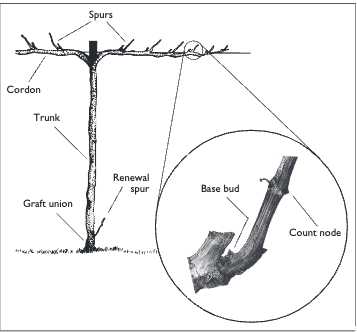
Grapevine pruning, especially if you’re growing for production, is a labor intensive endeavor that requires really knowing how these plants get the job done. Grapevine pruning is quite different from pruning fruit trees, it’s all about the buds. It is important to understand how many nodes to retain as well as which nodes are associated with good cold hardiness and fruitfulness. Sorry to all the Anheuser–Busch fans for this bad pun, but you have to know which buds are for you.
Grapevine buds have tightly packed shoots that will grow and produce grapes in the upcoming season. Keeping the fruitful buds and pruning off the outliers is the main way to configure the plant’s energy into producing a strong yield. If you aren’t in there working the vines this way when the plants are dormant you’ll find a tangled mess of excessive shoots and overcrowded leaf canopy that doesn’t get good airflow or sunlight penetration. Hello fungal disease infection. If infected leaves and branches are allowed to stay put, you’re looking at infection diseases getting into and through the wood. Over time, your vines will decrease grape production and eventually die out.
Your plants are in training - every year. When pruning, it’s important to snip off the 1 year old wood and keep specific buds which will grow out the following season. Eighty to 90 percent of the one-year-old wood is removed from vines later in the dormant season and before bud break. We’re doing it now in late winter, early spring to avoid cold injury. Different grapevine cultivars have different characteristics like cold hardiness and/or more fruitful secondary buds as several of the hybrid varieties do. The European bunch grape varieties are less cold hardy and have less fruitful secondary buds, which is why our sometimes late frost events cause plant problems.
The age of your vines also dictates some adjustments in your pruning approach. In the first 2 years after planting you are shaping the plant to create a permanent structure of trunk and cordon branches to make the intended plant trellis system work for harvesting. After permanent vine structures have been trained up and out, pruning (spur pruning for most of us) is done on 1 year old wood. The shoots that spring from the buds mature into canes over the season. We’re looking to keep canes to grow to 3-5 feet in length with a ⅓-3/8th diameter - almost a fat pencil size. Take out thin, dried, dead and hollowed out canes.
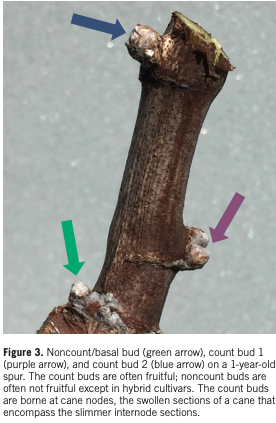
Buds with the compact future shoots in them are located at the nodes, which are the swollen sections of shoots & canes. It is important to understand how many nodes to retain as well as which nodes are associated with good cold hardiness and fruitfulness. Then there is the Grapevine Dictionary for us all to speak the same language about what is a bud that you “count” and one that you don’t count for pruning point decisions. It depends on where they are on the spur - the part of the cane we keep on the plant. Usually the cane we decide to keep will have 1-3 buds on it.
They are numbered in order going up from the base of the cane. The basal bud is first at the base where it connects to the cordon - this is named the noncount bud, as opposed to No Account Bud, which is that third cousin twice removed on Mama’s side who lays about all day doing not much of anything. The next 2 buds to keep are count bud 1 and count bud 2. There are mathematical formulas for this, that are cultivar specific if you really want to get down into the details. Choose healthy canes or nodes that show good wood maturation. The recommended shoot density is between 3-5 shoots per linear feet of canopy. For more information with details, contact me at minda_daughtry@ncsu.edu.
Below is the URL address of the Viticulture Management Guide with illustrations, graphics and timeline of what to do when, along with what diseases and insects to be on the look out for and how to handle those situations. https://smallfruits.org/files/2019/06/2018E-01-poster.pdf
Written By