Hot Pots – What?!?

(Updated: Feb. 14, 2025, 9:58 a.m.)

We’ve just experience bone chilling cold, so why is this article about how heat affects our plants. The answer:  Thinking back and planning ahead.  Dealing with the heat and lack of rain last summer was a challenge. Daytime max temps and nighttime minimum temps increase for part or much of the summer.  Not a newsflash. “It’s elementary Watson” - we need a plan for our plants to fight the stress.

But here’s a fun fact: While we tend to focus on protecting the plant foliage it’s the roots — which are adapted to a relatively cool and stable below-ground temp — are far more heat-sensitive.  As I’ve said many a time when purchasing plants in containers, if you have no roots, you have no plant so check the root zone before you buy. Now carry that idea back home.

In the summer, roots of plants in containers experience much higher temperatures than the above-ground portions. Black or dark-colored containers in the sun can heat up fast, resulting in soil temperatures that can be 20 to 30°F higher than the surrounding air temperature. Think about your car’s dashboard in the summertime.  How hot did we get last summer? OUCH!
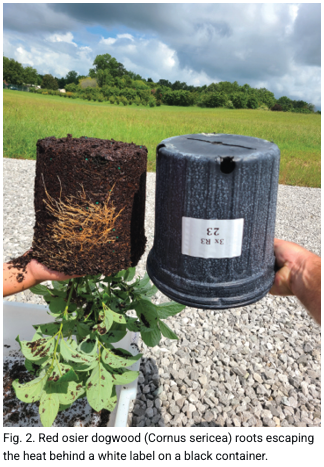
Roots escaping the heat

How about your plants in containers when we were in the 90º temps. The soil around the roots was likely hitting temperatures greater than 100°F. When that happens for five hours or 113°F for 30 minutes you can end up with severely injured roots that can no longer do their job to keep the plant growing and even surviving.

Another fun fact: your attempts at fertilizing your plants will be affected too, especially if you’re using a slow-release product.  Those products are formulated to activate under certain conditions. One of which is soil media temperature, usually around 70-80ºF. So slow nutrient release might not be slow and controlled anymore resulting in plant damage.

While we can’t control the weather, we can take action to help our container gardens this summer. Focus on managing the temperature of the soil media. The timeframe that you water, the temperature of that water, the color of the container and how the container is exposed to sunlight are strategies to use.  For more information contact me at minda_daughtry@ncsu.edu and we can talk about your container garden situation.